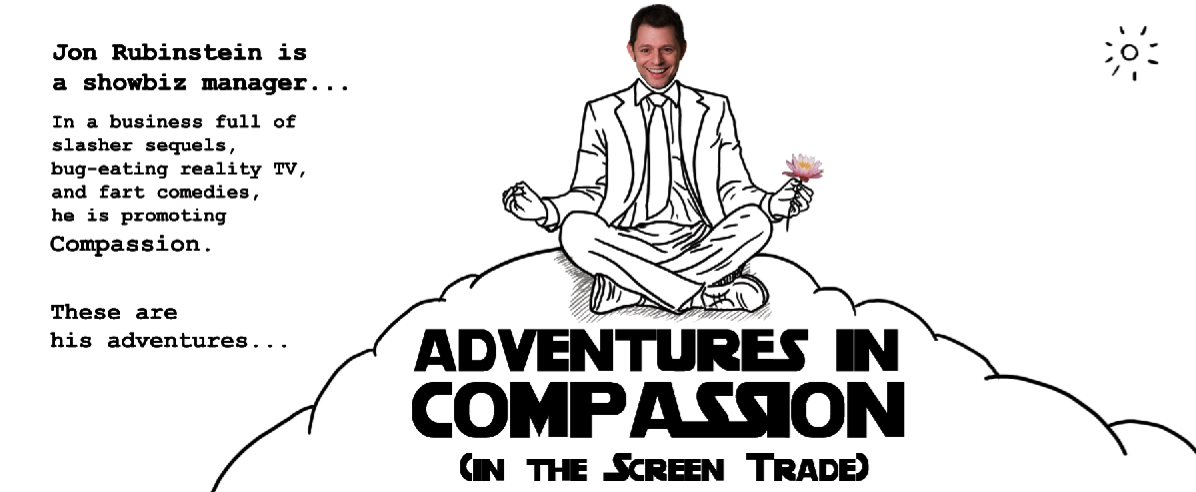
Showing posts with label actors. Show all posts

Wednesday, September 23, 2009

Finding Right Livelihood in Showbiz

Isn't that what this is all about? Right Livelihood? I picked up an old favorite, Thich Nhat Hanh's The Heart of the Buddha's Teaching. It's required reading for that Interdependence Project class I'm taking. So here's TNH on Right Livelihood:
"To practice Right Livelihood, you have to find a way to earn your living without transgressing your ideals of love and compassion. The way you support yourself can be an expression of your deepest self, or it can be a source of suffering for you and others."
Oh. That's all we have to do. Just earn a living without transgressing our ideals. No problemo!

Fortunately, Thay goes into more detail, particularly when it comes to artists:
"A composer, writer, painter, or performer has an effect on the collective consciousness. Any work of art is, to a large, extent, a product of the collective consciousness. Therefore, the individual artist needs to practice mindfulness so that his or her work of art helps those who touch it practice right attention."
So first, we have to acknowledge what's so. Our work has an effect on the collective consciousness. It's not inconsequential; it has a tangible impact on others. We can ignore this if we choose, but it still has an effect. Working mindfully allows us to have Right Livelihood, and to benefit those who are touched by our work.
"...everything we do contributes to our effort to practice Right Livelihood. It is more than just the way we earn our paycheck. We cannot succeed at Right Livelihood one hundred percent, but we can resolve to go in the direction of compassion and reducing suffering. And we can resolve to help create a society in which there is more Right Livelihood and less wrong livelihood."
I added those italics. Nice, right? I love that bit. Just because we can't succeed 100% doesn't mean we can't go in the direction of compassion. It's easy to throw up our hands and say, "it's impossible to ever really have Right Livelihood, so why bother?" An actor might star in a film and approach a role with compassion, with the intention of benefiting others. The actor might be working with a director or other actors who are focused on their own self-interest. If the film is successful, it might feed the profits of a large multinational corporation that might or might not share the actor's compassion. We know, however, that every cause has an effect, that our compassionate words and actions aren't lost in the void. Thay points out that we can still make a difference, to move towards our ideal of compassion, by practicing mindfulness in our work:
"If you are able to work in a profession that helps realize your ideal of compassion, be grateful. And please try to help create proper jobs for others by living mindfully, simply, and sanely. Use all of your energy to try to improve the situation....

...to practice Right Livelihood means to practice Right Mindfulness. Every time the telephone rings, hear it as a bell of mindfulness. Stop what you are doing, breathe in and out consciously, and then proceed to the telephone. The way you answer the phone will embody Right Livelihood. We need to discuss among ourselves how to practice mindfulness in the workplace, how to practice Right Livelihood. Do we breathe when we hear the telephone ringing and before we pick up the phone to make a call? Do we smile while we take care of others? Do we walk mindfully from meeting to meeting? Do we practice Right Speech? Do we practice deep and total relaxation after hours of hard work? Do we live in ways that encourage everyone to be peaceful and happy and to have a job that is in the direction of peace and happiness? These are very practical and important questions. To work in a way that encourages this kind of thinking and acting, in a way that encourages our ideal of compassion, is to practice Right Livelihood."
So that's what I've been going on about nonstop for the past several months. We can choose to support ourselves in a way that benefits others, and leads to happiness for ourselves and others, or we can remain ignorant, or we can create more suffering for ourselves and others. It seems pretty simple, doesn't it!

For more on Right Speech and Right Mindfulness and the rest of the Noble Eightfold Path, this book is a great place to start!

And don't forget - sponsor me in the Interdependence Project's 24 Hour Meditation Marathon! *
Share/Save/Bookmark

Saturday, September 12, 2009

Entertainment = Compassion 4Evah!

I'm doing a little light reading while here in Toronto; John Perkins' Confessions of an Economic Hit Man. A little break, I thought, from my usual reading list. This is about globalization and power, not about compassion, I thought. If what he says is true, it's horrifying; if it's even partially true, the world is being pillaged and people are being impoverished and murdered so that a tiny few (including me!) can live a life of extraordinary privilege. Perkins wrote the book, he says, as a confession, to come clean about the career and life he lived for decades:
"...this book is not a prescription; it is a confession, pure and simple. it is the confession of a man who allowed himself to become a pawn, an economic hit man; a man who bought into a corrupt system because it offered so many perks, and because buying in was easy to justify; a man who knew better but wh could always find excuses for his own greed, for exploiting desperate people and pillaging the planet; a man who took full advantage of the fact that he was born into one of the wealthiest societies the world has ever known, and who could also pity himself because his parent were not at the top of the pyramid; a man who listened to his teachers, read the textbooks on economic development, and then followed the example of other men and women who legitimatize every action that promotes global empire, even if that action results in murder, genocide, and environmental destruction; a man who trained others to follow in his footsteps. It is my confession."
Perkins does, however, offer a dream that got me a-thinkin':
"...those highly effective communications and distribution networks could be used to bring about positive and compassionate changes. Imagine if the Nike swoosh, McDonald's arches, and Coca-Cola logo became symbols of companies whose primary goals were to clothe and feed the world's poor in environmentally beneficial ways. This is no more unrealistic than putting a man on the moon, breaking up the Soviet Union, or creating the infrastructure that allows those companies to reach every corner of our planet. We need a revolution in our approach to education, to empower ourselves and our children to think, to question, and to dare to act. You can set an example. Be a teacher and a student; inspire everyone around you through your example."
You can set an example.

So I dare you to stop for a moment and use your imagination. Close your eyes if it helps.

Imagine that entertainment is a symbol of compassion. Imagine that when people think of actors, writers, directors, when they think of movie studios and movie stars, when they think of summer blockbusters and the Oscars, they think of compassion. They think of an entire industry that's devoted to compassion; whether feeding the hungry, caring for the sick, or simply honoring the human condition. Imagine that the primary goal of everyone in the entertainment industry is to care for the wellbeing of others. When a movie studio determines whether to make a film, the biggest question is, how does this serve others? When an actor chooses to take on a role, he or she is primarily thinking, what does this contribute to the world? Imagine that a young actor, writer, or director begins a career by thinking, how am I working to make the world a better place for others?

Okay, open your eyes.

It doesn't mean we give up profitability, or fun, or spectacle. There are a million places it's already happening, in compassionate performances, in compassionate filmmaking, in compassionate writing, in everyone who contributes to films that make a difference. It goes from low-budget documentaries like the amazing How to Fold a Flag that I saw yesterday, to the Oscar-buzzed Up in the Air and An Education, to Fox's new show Glee, to animation, to music, from poetry to design, from art to architecture. So what if that kind of work became the very definition of success; what if every young aspiring entertainer viewed themselves as a vehicle for contribution?

Think about this:

What if everyone knew that the entertainment industry was primarily interested in making the world a better place? What would that make possible? *
Share/Save/Bookmark

Tuesday, July 21, 2009

Casting Director Mark Bennett's "Thoughts on Compassion"

The prominent casting director Mark Bennett, whose recent credits include Kathryn Bigelow's stunning Hurt Locker, and Niki Caro's upcoming The Vintner's Luck, was kind enough to share his thoughts on compassion with us. I've known Mark for years, and have always found him to be smart and passionate, but I wasn't prepared for what he had to say about compassion. His thoughts truly echo my own, and it's no surprise that his work is of such consistently stunning quality given the genuine depth of his compassion. Thanks, too, to Monique Gabriela Curnen (full disclosure, an Authentic client) who Mark talks about in the piece.
THOUGHTS ON COMPASSION
Mark Bennett


Recently, an actress ca
me in to read for me for a film that I was casting. She was one of the many in LA who are talented but are still struggling - and it was a big role. She was visibly nervous, and said so.

"Why?" I said. "We're all in this together."

She looked at me like I was speaking another language.

And in a way, I probably was. The movie business is rough, and we're told so often that it's a bloodsport that we start to believe it. I see it happen to actors: the first time I meet them, they're usually happy to be there, excited to be able to practice their craft. A few
years later, some of the ones who haven't yet "made it" (and who are concerned with that sort of thing) start to feel jaded and bitter. They resent the process; they have a lot to say about other actors, always negative; they're bitchy in the waiting room and mean to the assistants. They are angry - and you can feel it in their work. They resent having been denied every role they've ever auditioned for, even the bad ones, mainly because they thought that that part could have led to a better part, which eventually would have led them…where? At what point would they have finally been happy?

When actors ask for advice on plotting their careers, the question I usually ask them is not, Whose career do you want?, but rather, whose life do you want? Will it really make you happy to get in that magazine? To make that much more money? No one lies on their death bed wishing that they had made more money.

I've been as guilty of this as anyone. For years, I chased imaginary carrots in front of my nose, trying to push to the head of the pack, and resenting those ahead of me. The problem with life is that there is always someone ahead of you - someone with more money, or more influence. Stubborn as I am, it took me years to learn this. I had bought the lie that society tries to sell us, that the world is defined by lack, and that the more that other people get, the less there will be for you.


Meanwhile, my life got incredibly small. I felt lonely a lot. In the words of Billy Wilder, "If you don't go to other people's funerals, they won't go to yours."

Now, I am a logical person; I am a big fan of whatever works. And I've come to discover that, more than anything, schadenfreude (rooting for other people to fail) is bad not just because it's bad for your karma but because it doesn't work. I see it with actors at auditions. The actors who book the jobs are the ones who are open, interested, who are happy to be there. It's the bitter or resentful ones that stink up the room, that get the bad reputations. Who wants to hire an actor who has a chip on their shoulder, who is ful
l of resentment? Ironically, it's that same grim resolution to succeed that keeps them from succeeding.

We all come into this world innocent, full of hope. As long as babies' basic needs are met, they are happy. That's why young children are such good actors - they have come not to impress or to achieve, but to play. Then that innocence gets drilled out of us and we spend years trying to get it back; as Sainte-Beuve said, "There exists in most men a poet who died young, whom the man survived." But we still all have the desire to tap into our innate creativity, to experience that moment of transcendence in which we are
most creative, and most generous. William Blake called this mysterious power the Imagination, and he said it was God.

So if you accept that we all start from that same place of innocence, then it is impossible not to feel compassion for others - and eventually, for yourself. Now, whenever I hear about a movie star throwing a tantrum on set, or a director dressing down some poor p.a., I think, Wow. They must be one frightened little child, to feel like they have to fight so hard to prove their own importance. And then I say a little prayer for them.

Now when I say a "prayer", I'm not referring to working within any
organized religion or belief system. By prayer, I mean just good wishes, a happy little thought. Whenever actors are anxious about an audition, I tell them, "Say a little prayer, first for yourself and then for everybody else in the room - even the other actors. You'll feel generous and less resentful, and then your work will get better." And it does. I see it all the time.

I like to refer to my friend Monique Curnen. I first met Monique years ago, when she was an actress just starting out in New York. What always distinguished Monique, even more than her talent, was her generosity. She always showed up happy to be there, and eager to be of service. Because
of this, people rooted for her, and she steadily built up her resume. Two years ago, I was delighted to receive a call from Monique, in which she told me she had to cancel our plans because she'd booked a role in a film.

The film? The Dark Knight.

Right after that, she booked a lead on a TV show, and has been working steadily ever since. Throughout it all, she has remained a really nice person, even since moving to LA (which is no mean feat).

She's going to have a very long career.

Like I said, I am a logical person: I practice compassion because it works. Simple as that.
Do you hear that, actors? Mark casts major movies, and he's telling you that compassion works. Not just in theory--in real, live practice!

Wow, Mark. Thanks so much. I'm sitting here trying to think of something to add, and I can't think of anything.

*
Share/Save/Bookmark

Monday, May 18, 2009

Save the Children's Jane Berliner - Taking Risks in Art, and Seeing the Suffering of Others

Jane Berliner was an agent at Creative Artists Agency for the better part of her adult life, and she later transitioned to her current post as the director of the Artist Ambassador Program at Save the Children. I was fortunate enough to work with Jane when she was at CAA, and I count myself very lucky to work with her in her current post as well.

Jane is a rare gem; she was an extraordinary agent, and she represented some of the biggest actors in the business for a long time. And her passion and commitment to the work she does with Save the Children is absolutely spectacular. You can read more about our recent work together on my "Noticing the Other" posting, as well as as this posting on Authentic's Community Page.

So given the apparent but illusory dichotomy of Jane's career, I thought she'd be a perfect candidate to discuss her thoughts on compassion in the arts.


Here's Jane talking about what it was like working with some of the world's biggest stars, and watching them prepare to take on a role.

“I've seen my former clients be compassionate about characters they play, even some tough characters to enjoy and like... what I can tell you that I witnessed is a complete commitment to getting to know not only the character, but the character's immediate family, or community.”

This is not all that different from what Tom Hiddleston described a month ago:
"'suffering with' means taking on another's suffering as your own, a deep kind of understanding and connectedness with another human being. Having compassion for people as a whole, for the whole palette of humanity, all of us with all strengths, weaknesses, our flaws, our nobility and fragility."
Jane went on to describe why work created with a compassionate heart is attractive to her as an audience member:
“I get a much more fulfilling experience because I have a more complete picture of this person when they're created out of compassion. I think that there's a tremendous effect on the result when the process is that thorough.... If you don't get out there and really risk changing up your own life to the point where you get to know another's life, really know it, once you do that risk, then it will show up in the work. It must show in the work. Because it's now in you. It's a part of you."
As I said recently:
"by being present to the fact that the people I was meeting were fundamentally no different from my own family, no different from me, I was momentarily shaken out of my fog, and I briefly understood the necessity for compassion. I am often and ordinarily preoccupied, but being in this unique circumstance shifted my awareness."
When an actor takes on that risk for us, it shows up in the work, and jars us into awareness of our fundamental sameness. This attention to detail, this thoroughness Jane describes, strikes us, as audience members, as real, and we're attracted to it because of that. Hence, Jane's "more fulfilling experience."

And because Jane has worked in two such apparently separate worlds, she's privy to the somewhat obvious connection between them:
“Working with Save the Children, the people that I see coming and working with us, I think are true artists, not celebrities.... I would have to say that whatever it is that they're seeing the suffering of fellow humankind, I am certain the compassion that rises because of that experience finds its way into the art. I'm sure of it.”
Thank you, Jane, for sharing your thoughts, and for being such a compassionate force, making a difference for millions of children worldwide. *
Share/Save/Bookmark

Friday, May 8, 2009

Casting Director Kim Miscia - "Compassion in the arts is just like compassion in one's everyday life"

Kim Miscia, who's a friend and a highly respected casting director here in New York City, shared her thoughts on compassion and how it relates to her work:
"Compassion in my field of the arts, casting, has shown its face to me in many instances over the years...

...like the face of the megastar TV and film actress/producer, who went out of her way to make a nervous young actress comfortable before she began her audition.

...or the face of a famous theater director who laughed heartily at every person's audition for a comedy--whether they were funny or not.

...or the face of an award winning writer, who, when an actor fumbled with his lines, reassured the young man that the words weren't important--he was getting the intention just right.

...or the face of the legendary actor teacher who, as an actress drowned in her audition monologue, took her aside and whispered in her ear, transforming her performance.

To me, compassion in the arts is just like compassion in one's everyday life--it's about putting yourself in another person's shoes and feeling empathy for them in that moment--letting them know that they're okay, and that they're not alone. Put more simply, compassion is about making the effort to let others know in tough times--not just in the sunny times--that you are no different from them."
What I really want to highlight in Kim's sharing is the presence of compassion in some of the most successful people in the business: a big TV star, a director, a writer. I'm going to reach a bit here, because I know who the people are she's referring to! These artists, their success, and the compassion in their hearts is not coincidental. The compassion she's talking about is evident in their work. When this particular actress takes on a role, she's so clearly and deeply connected to the character, and its impact on her audience, that people can't help but identify themselves with her. That's not something you turn on and turn off; it's her way of being. If an artist wants the ability to connect with an audience, to create a real emotional resonance in his or her work, compassion is utterly necessary.

Thanks, Kim! *
Share/Save/Bookmark

Friday, April 3, 2009

Kat Foster on Compassion

Here's the beautiful and talented Kat Foster, known from Fox's TIL DEATH and soon to be seen on ABC's THE UNUSUALS, talking about compassion and what it means to her and how it relates to her work. How amazing is Kat??

I love the fact that Kat's definition of compassion is not all that different from Robert Thurman's, who's spent years studying it!

"Compassion is an ability to feel the pain of others, embrace someone's feelings as your own, to put yourself in someone else's shoes."

*
Share/Save/Bookmark

Sunday, March 22, 2009

Why Compassion, and Who the Heck am I to Say Anything About It?

Have you ever watched a character in a film who was nothing like you on the surface, but somehow, you felt like you understood them? Or possibly even more significantly, like they understood you? That there was something in their being that felt totally human, that reminded you of yourself, or a friend, of your family?

Have you ever walked away from a play, or even a TV show, feeling like you understood something differently? That a new point of view that you hadn't previously considered was suddenly as plain as the nose on your face?

I've been working in the entertainment business for close to twenty years, and for many of those years, I was convinced that the business I was in was like any other; it was strategic. You did one thing to achieve another, which led to another, which led to a desired result. An analogy might be that we at SodaCorp repackage our soda in convenient Fridge-Packs™ which would allow the grocers who sell our soda to utilize shelf space more efficiently, and would allow consumers to have a convenient way to store our soda in their refrigerators. We'd have plenty of choices for each consumer's individual taste: regular cola, diet, ginger ale, lemon-lime, even root beer. Something for everyone, each in a convenient Fridge-Pack™ . Consumers would consume more of our product, which would eventually feed back to us as higher profits.

Think about it. An actor comes to Los Angeles or New York, and we, the representatives, the teachers, the casting directors guide them into the right kind of packaging in order to make them the most appealing to the consumers. We guide them to look to the others who have come before them, not as an example of someone who's looked deep into their own heart and found their own, personal path, but as someone to imitate. The windblown hair, the white shiny teeth. The chiseled abs. The casual way they deliver a joke, or how their eyes glisten as they deliver the emotional knock-out blow.

And, for a time, it works. If we package it right, if the goods are of a certain quality to begin with, and there's enough shelf space in that particular section of the market, it flies off the shelves.

For the better part of twenty years, I thought that's how it worked. And apparently, so do a lot of artists. For many, it's all about in order to. I'll do this TV series in order to get the movies I want. I'll do this genre movie in order to be considered for the movies I really want. I'll take this job in order to make the money I need, so that I can do this play in order to be considered a serious actor. I'll try and be more like him in order to get the jobs I want.

I'd spent years strategizing, trying to figure out the “right” next move for each client so that they could someday
have what they wanted. And it was working out! I could point to my strategies and see how they'd been productive. If they hadn't worked out, I could point to some unforeseen outside circumstance, something beyond my control that had gotten in the way of my master plan. Of course, I never got full credit in success, because I was never willing to take full responsibility. I couldn't say “do this,” I'd say “it sounds like this is the right choice, based on your feelings and concerns.”

Unknowingly, I was actually exploring a very different territory with my clients, though not with full awareness and therefore not with full power. When I heard them talk about the work to which they were truly drawn, I couldn't help but be touched, moved, inspired, and to support them in their endeavors. It wasn't passive; their passions became mine, and I'd find myself torn between the strategy I thought made sense, and the inspiration I felt in my heart.

Poet and author David Whyte says, in his astounding book The Heart Aroused:

...if we can see the path ahead laid out for us, there is a good chance it is not our path; it is probably someone else's we have substituted for our own."


I started my company in early 2005, thinking I knew the path laid out ahead of me. But when I was finally in charge, when I could no longer claim I had to live within someone else's worldview, when I realized I was personally responsible for my own point-of-view, I started thinking about what actually inspired me, instead of what I thought should inspire me.

And there it was, right in front of me. Every single artist who truly inspired me, who brought me to tears, who brought me to a new understanding of what it means to be human, who made me laugh, and who inspired me to action, had something in common:

Compassion

My client Tom Hiddleston, about whom who you'll be hearing quite a lot, is quite accomplished with his Latin. Tom says:

"Passion" is from the Latin verb "patior" meaning "to suffer" (participle is "passus" meaning "suffering"). And the "con" part in the preposition meaning "with.” So - literally "suffering with" means taking on another's suffering as your own, a deep kind of understanding and connectedness with another human being. Having compassion for people as a whole, for the whole palette of humanity, all of us with all strengths, weaknesses, our flaws, our nobility and fragility. That's what compassion means to me as an artist. An understanding that no character's suffering or insecurity or weakness or fear or strength is any greater or smaller than my own. ... "patior" has a second meaning in Latin, which is "to allow, "to acquiesce,” "to submit.” So I suppose etymologically "compassion" carries within it an essence of permission, acquiescence, acceptance. Which deepens my understanding of it in terms of having compassion for the characters I play even more.


Another smart guy (H. H. The Dalai Lama) said this:

Whether people are beautiful and friendly or unattractive and disruptive, ultimately they are human beings, just like oneself. Like oneself, they want happiness and do not want suffering. Furthermore, their right to overcome suffering and be happy is equal to one's own. Now, when you recognize that all beings are equal in both their desire for happiness and their right to obtain it, you automatically feel empathy and closeness for them. Through accustoming your mind to this sense of universal altruism, you develop a feeling of responsibility for others: the wish to help them actively overcome their problems. Nor is this wish selective; it applies equally to all. As long as they are human beings experiencing pleasure and pain just as you do, there is no logical basis to discriminate between them or to alter your concern for them if they behave negatively.


Wow, that's a lot to take on. Here we have an artist's point-of-view, and we have the point-of-view of a religious leader who's spent his entire life studying and meditating on compassion. And it sounds to me like they're coming from the same place.

Except here's what I see, every day:

Dude

Dude, you're a manager?

Me

Yeah, that's right.

Dude

Cool, dude, like in Entourage!

Me

Ummm.... yeah.

That ummmm... yeah is me being judgmental, by the way. Not very compassionate of me, I know! But it's not really a true story, it's one I made up to make a point about what is right now. So I'm being judgmental of an imaginary character. That's ok, right? Ermmmm..... oh yeah. Here's what is:

Every day, I encounter people who see entertainment as mercenary, it's about getting something in order to get what they really want, it's about strategy and business planning. And this comes from a group of people who generally got into it completely inspired, people interested in human connection, creativity, and making an impact in the world.

Naturally, this leads to people in the biz feeling resigned, disappointed, and beaten down. They suffer through their work because they have to, they do work thinking it's what they need to do, and very often and very quickly the inspiration and passion that they'd hoped to have in their careers and lives gets drained away. And anyone even considering getting into the entertainment business is led to think that this is how it works, that entertainment is about anything but compassion, it's about business school, and spreadsheets, and foreign sales value.

There's a deep cost to the world that comes from this kind of behavior. We're suffering, and we're being deprived of the things that bind us, that show us what we have in common, that give us hope.

And where does that lead us? To a world full of entertainment created by the uninspired. Sure, there are exceptions, but in a world where artists are being told to focus on business strategy, those exceptions are sure to become rarer and rarer.

Can you imagine a world where careers full of compassion, inspiration, and creativity were commonplace? And what that might make available in the world?

What I have noticed is pretty simple:

  1. Compassion is at the center of every career that truly inspires me.
  2. Compassion is the key to the most extraordinary career possible.
  3. Compassion is the key to making the most extraordinary impact possible
  4. Compassion is the key to the happiest life possible.
Wow! Big leap! Especially #4. I mean, seriously, who the heck am I to make that assertion? I'm just a poor suffering schmuck, but there are much smarter people than me who agree:

Again,The Dalai Lama:

The more we care for the happiness of others, the greater our own sense of well-being becomes.


And again:

If you want others to be happy, practice compassion. If you want to be happy, practice compassion.


Another smart guy, Shantideva, from The Guide to the Bodhisattva's Way of Life.

All those who are unhappy in the world are so as a result of their desire for their own happiness. All those who are happy in the world are so as a result of their desire for the happiness of others.


Oh, you think it's only a Buddhist thing, right?

Thomas Browne Sr.

By compassion we make others' misery our own, and so, by relieving them, we relieve ourselves also.


George Washington Carver

How far you go in life depends on your being tender with the young, compassionate with the aged, sympathetic with the striving and tolerant of the weak and strong. Because someday in your life you will have been all of these.


St. Teresa of Avila

Yours are the eyes through which Christ's compassion for the world is to look out.


Albert Schweitzer

It is a man's sympathy with all creatures that truly makes him a man. Until he extends his circle of compassion to all living things, man himself will not find peace.


Mohammed

No man is a true believer unless he desireth for his brother that which he desireth for himself.


Hasidic Proverb

He who feels no compassion will become insane.


And that's the intention of this project, to show how 1, 2, 3 and 4 are possible, and to inspire others to take on compassion as a focal point for their own lives and careers. We'll be seeing video commentary from some amazing people, each with their own personal point-of-view on compassion and how it relates to their work. Along the way we'll be hearing from actors, writers, directors, acting teachers, writing teachers, Zen teachers, educators, people from the nonprofit world, students, and anyone else who has something to say.

I am particularly thrilled to have the participation of Peace Games in this project. Peace Games' mission is to support young people as peacemakers through programs in elementary and middle schools. I have long been impressed with Peace Games' focus on compassion, communication, and activism. Peace Games' students, volunteers, and staff members will participate on our site in a dialogue, responding to the postings on compassion. We'll get to see the direct effect of the videos on young people. The dialogue between members of the Peace Games community who aim to foster compassion in their schools and neighborhoods, and professionals who value compassion in their work, will be an exciting concept around which to build a unique online community.

As a result of this partnership, not only is there an opportunity to inspire our Peace Games community, but an opportunity to reach thousands worldwide and energize them about the value of compassion in their own lives.

Come back to our site for regular updates, videos, essays, and commentary, showing how compassion has made a difference in the lives of our participants, and to get inspired by seeing how it can make a difference in your own life. *
Share/Save/Bookmark