Showing posts with label Eckhart Tolle. Show all posts

Tuesday, September 29, 2009

The Dharma of High School Musical Part 2 - "Get'cha Head in the Game"

I want to be really, super clear here, because I've had hesitations about writing more postings like the one I wrote last week.

Here's the thing. I am not joking. I really, honestly think there's a Dharma lesson in the song "Fabulous" from High School Musical 2. I can't say whether this was intended by the song's authors, but I genuinely heard a lesson in the song after probably the thousandth time I'd listened to it. The lesson had been there all along, but it took the right causes and conditions for me to "get it."

I say this with the deepest respect and reverence for the Buddha's teachings, and also knowing that I am a complete novice when it comes to my understanding and analysis. This is why I go to pains to quote impeccable sources, teachers who have a much greater understanding than I have or perhaps ever will. Most of them are tagged over on the right hand side of this page. I welcome any clarification or rebuttal of any of anything I put forth; like I said, I'm no scholar.

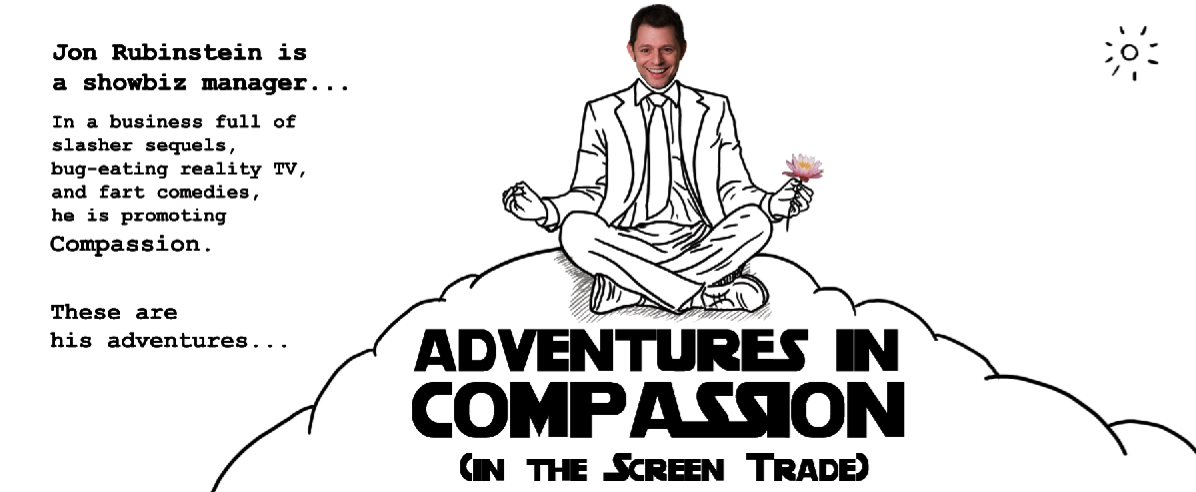
My intention in my work on this site is to inspire others to take on compassion as a focal point in their lives and careers. Often, this veers into other, related areas of Buddhist study, but they're all closely connected. As someone who's in the entertainment business, I think it might be helpful to point out that there's room for a powerful teaching in any medium, whether it be a small, heartfelt movie, a Broadway musical, or a Disney Channel teenfest.

And perhaps part of the reason millions of fans connect to the High School Musical films is the thread of compassion that runs through all of them. We are no different from Sharpay, each of us always wanting the newest toys, and justifying it to ourselves like she does.

And that leads me to my next observation:

Last night, after my amazing nine year old daughter Lily made us dinner (for real!) I asked her to list all the songs from High School Musical, so that I could search for more Dharma lessons. Her equally amazing brother Eli shouted out "Get'cha Head in the Game," and I knew immediately he was on to something.

Watch the video:


The lyrics are a stunning back and forth between the running monologue in Troy's head, and what he knows to be important, that he simply must "get his head in the game." It's like two voices, battling for Troy.

Here's worried Troy remembering all the things he's been told to do:
Coach said to fake right
And break left
Watch out for the pick
And keep an eye on defense
Gotta run the give and go
And take the ball to the hole
But don't be afraid
To shoot the outside "J"
And then mindful Troy simply remembers that none of this is possible unless he's here, in the present moment:
Just keep ya head in the game
Here's worried Troy talking about the past and the future, both in the same verse:
Let's make sure
That we get the rebound
'Cause when we get it
Then the crowd will go wild
A second chance
Gotta grab it and go
Maybe this time
We'll hit the right notes
"Let's make sure that we get the rebound," is worried Troy worrying about the future. "Maybe this time we'll hit the right notes," is worried Troy comparing to the past.

But then mindful Troy reminds us what's important:
Wait a minute
It's not the time or place
Wait a minute
Get my head in the game
Wait a minute
Get my head in the game
Wait a minute
Wait a minute
There is such a simple and profound lesson here. Thich Nhat Hanh says, in "The Miracle of Mindfulness,"
"Joy and peace are the joy and peace possible in this very hour of sitting. If you cannot find it here, you won't find it anywhere. Don't chase after your thoughts as a shadow follows its object. Don't run after your thoughts. Find joy and peace in this very moment."
Thay later quotes Tolstoy in the book:
"Remember that there is only one important time and that is now. The present moment is the only time over which we have dominion."
Even more recently, Eckhart Tolle shared similar sentiments in The Power of Now:
"When you are present in this moment, you break the continuity of your story, of past and future."

"Nothing ever happened in the past; it happened in the Now. Nothing will ever happen in the future; it will happen in the Now."
These great teachers seem to be saying the same thing: "Get'cha head in the game."

This doesn't mean that Troy should give up! As Tolle says in The Power of Now:
"For example, if you were stuck in the mud somewhere, you wouldn't say, 'Okay, I resign myself to being stuck in the mud.' Resignation is not surrender. You don't need to accept an undesirable or unpleasant life situation. Nor do you need to deceive yourself and say there's nothing wrong with being stuck in the mud. No. You recognize fully that you want to get out of it. You then narrow your attention down to the present moment without mentally labeling it in any way. This means there is no judgment of the Now. Therefore there is no resistance, no emotional negativity. You accept the 'isness' of this moment. Then you take action and do all you can to get out of the mud."
Troy can "get his head in the game," accept the "isness" of the current moment, and then take action and do all he can to win the game! How profound this is, when we all spend so much time worrying about what actions we need to take, how we've done them the "wrong" way in the past, and how concerned we are that we'll repeat our mistakes in the future. But while we're worrying, we've created a world where "something's wrong," and we're unable to take any action other than to fix what we perceive to be wrong. If Troy's worrying about getting what the coach said "right," he's not going to be able to react and play to his fullest ability. Likewise, when we're worrying about what might happen, or what happened in the past, we're unable to really act from any place of strength; we're simply reacting, on full automatic.

And when we're reacting to the past, or worrying about the future, we're likely to be defensive, angry, and self-centered––and much less likely to be compassionate. *
Share/Save/Bookmark

Wednesday, September 2, 2009

The Actor and the Casting Director - Fay Wolf and Sara Isaacson on Compassion from two different points of view

Fay Wolf and Sara Isaacson have been doing a series of videos I've really enjoyed called "The Actor and the Casting Director." They're really funny, and they manage to discuss some pretty important issues in the context of casting and acting.

In the course of this entry, which they kindly created for Adventures in Compassion, they talk about self-compassion, presence, negativity and sabotage.


Listen to Fay talk about working on the tv show Numb3rs and managing to be completely present in a scene. How she's not doing it in order to get something else, but she is simply there in the moment.
"This is what I'm doing. I'm not here so that this can be a great thing to put on my reel...."
Ade quod agis. Do what you are doing. As Thich Nhat Hanh said,
"Life can be found only in the present moment. The past is gone, the future is not yet here, and if we do not go back to ourselves in the present moment, we cannot be in touch with life."
By being present, even in a scene on a long-running TV show, Fay allows herself to fully enjoy the moment, and give of herself. She's being truly compassionate to everyone around her by doing so––not driven by the ego that would tell her, notice me, notice me. Instead, she's serving the other actors, the director, the crew, the writers, and the show at large. She's making something available to the audience that would be distracting if she were focused on herself. And simply doing so can bring her joy!

Here's Eckhart Tolle from The Power of Now:
"Unease, anxiety, tension, stress, worry — all forms of fear — are cause by too much future, and not enough presence. Guilt, regret, resentment, grievances, sadness, bitterness, and all forms of nonforgiveness are caused by too much past, and not enough presence."
And by caring for that one moment, by being compassionate in that moment, something great is possible. Here's Eckhart:
"The great arises out of small things that are honored and cared for."
Hey, I get that she's talking about an episode of Numb3rs. But she's taking responsibility for that one moment, and if she can manage to do that there, imagine what's possible as she takes on other roles.

Sara, as the casting director, observes that she often sees another way of looking at work from actors:
"I wanna audition so that I can like be on TV shows so that I can like, update my status on Facebook saying that I just booked an episode of something."
That's entirely about ego, about grasping for status. The Buddhist term dukkha, which is roughly translated as "suffering," or "stress," comes from craving; it's the Second Noble Truth. You wish for things to be a certain way that they are not. We wish for money, and when we have it, we worry that we will lose it. We wish for good health, and want it to always be that way. Whether a wish for status (even the Facebook kind) or material things, or the wish that we not get older, or get sick, or die, all suffering comes from desire. We wish for things that are naturally impermanent to be permanent. Here's Thich Nhat Hanh again on the topic:

"If you suffer, it is not because things are impermanent. It is because you believe things are permanent. When a flower dies, you don't suffer much, because you understand that flowers are impermanent. But you cannot accept the impermanence of your beloved one, and you suffer deeply when she passes away.

If you look deeply into impermanence, you will do your best to make her happy right now. Aware of impermanence, you become positive, loving and wise. Impermanence is good news. Without impermanence, nothing would be possible. With impermanence, every door is open for change. Impermanence is an instrument for our liberation."

Think about it: if you're doing the work to get that brief hit of status, that quick jolt to the system that comes from being able to tell people "I got a job," or "I'm on a talk show," or "I'm on the cover of a magazine," then the moment that has passed, we're simply back to being junkies looking for another fix. When you're basking in the glow of your freshly updated Facebook status, you're immediately mourning its impermanence. Fay's comment points out that we can simply enjoy the moment we're in, and be compassionate to ourselves and to others by doing so.

Fay goes on to talk about how having that compassion for ourselves creates an impact:
"Let's have compassion for ourselves and own the fact that we are all awesome... you're an awesome casting director, I'm an awesome actor, and if I don't wholeheartedly believe that about myself when I'm walking into an audition room, how in the hell are you gonna think that?"
Sara, the professional, answers it simply: "I won't."

Thanks, Fay & Sara!!! Make sure to check YouTube for their latest videos everyone! *
Share/Save/Bookmark

Sunday, June 7, 2009

Eckhart Tolle, Jim Carrey, and Melissa Etheridge at the Global Alliance for Transformational Entertainment Event - June 4 2009

On Thursday night I went to the Global Alliance for Transformational Entertainment [GATE] event at Fox. I was really excited to be there, mainly because Eckhart Tolle was scheduled to speak. I'm a big fan of his books A New Earth, and particularly, The Power of Now. I actually listened to the entire Oprah ten hour podcast about A New Earth, though I suppose in the spirit of the book I might have benefitted from just listening instead of running around Prospect Park while listening. And Eckhart did not disappoint. I'll get to that in a moment.

The theme of the evening was “Transforming the World by Transforming Media and Entertainment,” and though it was a bit long, it was really inspiring and I took away a few things that I thought were in alignment with this site.

The intention of the evening was to show how media and entertainment can cause transformation in the world, causing “humanity's awakening... to the truth of who and what we are, and what we are here for.”

Sounds pretty good to me.

From The Hollywood Reporter:
"Clearly, these are times of unprecedented transformation, both individually and globally,” says [GATE] founder John Raatz. “Everywhere you look, people are questioning values, identity, and meaning. We’re intending for GATE to support entertainment and media professionals who realize media’s power to effect positive change, and want to contribute to this transformation through their work.”
Rather than reviewing the entire evening, I'd like to address a few key points that are particularly relevant to this site:

First off, and most importantly:

Eckhart Tolle is a big Seinfeld fan.

I mean, who'd-a-thunk-it?

I had him pegged for That's So Raven.

Okay, seriously.

Melissa Etheridge talked and performed, and I was totally blown away. Some of you who are fans of Ms. Etheridge might not be surprised by this, but being momentarily on automatic pilot, the judging, assessing machine that I am completely dismissed her when I saw her on the program. Ya see, I'm into really cool music, not that pop crap that's on the radio. And so, because Melissa Etheridge was unfortunate enough to sell millions of records and have huge airplay, I decided she wasn't worth paying attention to. Yay me!

If you're not getting the tone here, it's ironic. Sometimes hard to pull that off in print. Anyway check Dawn Andrews' recent post for clarification; the same thing happened to me that happened to the slam poet in her story. Melissa Etheridge opened her damn mouth and I was completely blown away by how funny she was, how honest and personal she was, and how what she had to say about her life and career was something I completely understood. I'm not going to do her speech the injustice of trying to paraphrase it here, but suffice it to say she talked about the immense success she had and how empty it ultimately felt, and her subsequent fight with cancer, and her spiritual awakening. And then how Al Gore called her and wanted her to write a song for his little movie. And then she sang I Need to Wake Up which apparently won her an Oscar. Wow, she can sing. Who knew?

So that's lesson one I took away from this evening. When I'm judging and assessing, I'm not actually paying attention, but I was fortunate enough that she was so amazing, she shook me out of my fog and I actually started listening.

Lucky for me.

Jim Carrey was awesome too. I have not been a fan in the past, and in fact I have often sneered as I said his name. Like this:

Oh, I just can't wait until they remake Being There. Except instead of someone who'd play it totally real like Peter Sellars, they'd hire, like, Jim Carrey, and he'd do a funny voice the whole time.

That little piece of compassionless judgement was eradicated after watching this video.


That dude is freakin' funny! I might just rent The Yes Man at some point. Or if it's on a plane. Seems like a plane movie.

On to Eckhart.

John Raatz has talked about the media's power to effect positive change. Eckhart Tolle talked on Thursday night about different ways that's already happening. And in my view, all of the ways he discussed ultimately point to compassion.

Eckhart talked at length about impermanence, which is a fundamental concept in Buddhist studies. In fact, it's called the First Dharma Seal. But it's common sense: everything is changing, all the time. Nothing is exactly the same as it was a moment ago, or a year ago. From Thich Nhat Hanh's The Heart of the Buddha's Teaching:
“The Buddha taught that everything is impermanent––flowers, tables, mountains, political regimes, bodies, feelings, perceptions, mental formations, and consciousness. We can not find anything that is permanent.”
Eckhart pointed out that media that portrays impermanence effects transformation. He pointed out the film Titanic, and how it showed the young Rose and the elderly Rose, as well as the gleaming new ship rising from the image of the wrecked ship underwater. These remind us of the impermanence of life, which, in turn, reminds us to embrace the present moment.

From Thich Nhat Hanh:
“Understanding impermanence can give us confidence, peace, and joy. Impermanence does not necessarily lead to suffering. Without impermanence, life could not be. Without impermanence, your daughter could not grow up into a beautiful young lady. Without impermanence, oppressive political regimes would never change. We think impermanence makes us suffer. The Buddha gave the example of a dog that was hit by a stone and got angry at the stone. What makes us suffer is wanting things to be permanent when they are not.

We need to learn to appreciate the value of impermanence. If we are in good health and are aware of impermanence, we will take good care of ourselves. When we know that the person we love is impermanent, we will cherish our beloved all the more. Impermanence teaches us to respect and value every moment and all the precious things around us and inside of us.”
Tolle, and Thich Nhat Hanh, understand the importance of recognizing the pervasiveness of impermanence in our lives, and Tolle points out that being reminded of this by film creates an opportunity for transformation.

So the $64,000 question is, how does this relate to compassion? We don't really know whether Jim Cameron told the story in the way he did because he wanted to teach his audience a lesson in compassion. But the work itself is fundamentally compassionate, because it tells a story that connected to millions of people. Think about it. People watched Titanic, and felt connected to it, not simply because of the enormous spectacle, but because of the human story. We've seen plenty of examples of hugely expensive films that came and went, and plenty of them made a fair amount of money. But Titanic was a phenomenon, and a great deal of credit for that has to go to the inherently human story at its core. Part of that human story was this implicit reminder that we all age, we all decay, and like the lovers at the center of this story, we can only seize this very moment not knowing what's around the next corner.

Tolle also talked about the amazing film Groundhog Day, and how Bill Murray's character is stuck in an endless loop, repeating the same day over and over until he finally starts to grow out of his self-centeredness. Tolle talked about how Murray's character finally learns to accept the present moment, and accept and befriend those around him, finally finding real love rather than empty seduction.

At its core, a lesson in compassion. A story about a man who's stuck in an empty life, angry, unhappy, and doomed to repeat every day the same way until he grows. An exaggeration, perhaps, but not an extreme one––how many of us live the same day over and over, angry, unhappy, stuck in our story and unwilling to change except in ways that benefit us, directly, in the short-term. And the message here is that when Murray's character finally starts to realize how stuck he really is, he starts to take a different path.

What's clear to me is that each film had a massive impact on its audience. By genuinely and deeply exploring the nature of human beings and their relationships, the filmmakers of each film were able to connect to an audience in a profound way and effect transformation––whether by highlighting the impermanence of life, and the value of cherishing every moment, or by showing how we're doomed to repeat the same thing over and over until we finally start to genuinely connect to others.

So if you want to really connect to an audience, consider compassion. If you want to make an impact, consider compassion. If you want to be happy, consider compassion.

Thanks so much to John Raatz, Eckhart Tolle, Jim Carrey, Melissa Etheridge, and the evening's other speakers, who made it crystal clear how media and entertainment can have a transformational effect on the world. And from my (admittedly biased) point-of-view, for that transformation to take place, a focus on compassion is fundamental. *
Share/Save/Bookmark

Monday, May 18, 2009

Peace Games' Rena Deitz - "...the recipe for compassion is simple ... to get it right takes practice"

Our friends at Peace Games have been sharing the work on this site with their staff and volunteers. Rena Deitz, a Development and Communications Intern at Peace Games, had this to say about James Suskin's "Recipe for Compassion":
"James Suskin has it right. The recipe for compassion is simple, and has only a few ingredients. However, much like the recipe for a soufflé, to get it right takes practice and expertise. That is where Peace Games comes in. As an intern in Development and Communications at Peace Games I thought I would be dealing only with logistics and fundraising. Instead, everyday I work with compassionate individuals who teach children how to combine the ingredients: people, time and infinite space. By sharing their compassion, they give children the practice and expertise to be compassionate peace builders in their community."
I was inspired by reading this, because it reminded me that compassion exists in all of us as a possibility; each one of us has the capacity to be compassionate at any given moment. If a moment arises where we forget to be compassionate, we need not regret; we must simply be compassionate, and take compassionate action in this very moment. And as Peace Games' work reminds children to be compassionate––or, perhaps, gives them the tools and opportunity to recognize their own, intrinsic, compassionate selves––so can the arts remind all of us to be compassionate in our daily lives.
"Each moment is a chance for us to make peace with the world, to make peace possible for the world, to make happiness possible for the world." - Thich Nhat Hanh

"Compassion is the awareness of a deep bond between yourself and all creatures. But there are two sides to compassion, two sides to this bond. On the one hand, since you are still here as a physical body, you share the vulnerability and mortality of your physical form with every other human and with every living being. Next time you say 'I have nothing in common with this person,' remember that you have a great deal in common: A few years from now -- two years or seventy years, it doesn't make much difference-- both of you will have become rotting corpses, then piles of dust, then nothing at all. This is a sobering and humbling realization that leaves little room for pride. Is this a negative thought? No, it is a fact. Why close your eyes to it? In that sense, there is total equality between you and every other creature." - Eckhart Tolle
*
Share/Save/Bookmark